Outsourced PACS administration and imaging informatics.Plus the software your imaging practice runs on.
Minuswires supports radiology groups, outpatient imaging centers and hospital imaging departments — day-to-day PACS, VNA and RIS operations, DICOM and HL7 integration work, PACS/VNA migrations and cutovers, and the referral, results and dashboard software that sits on top of all of it. Based in Sparta, New Jersey; on-site across NJ and NYC, remote nationwide.
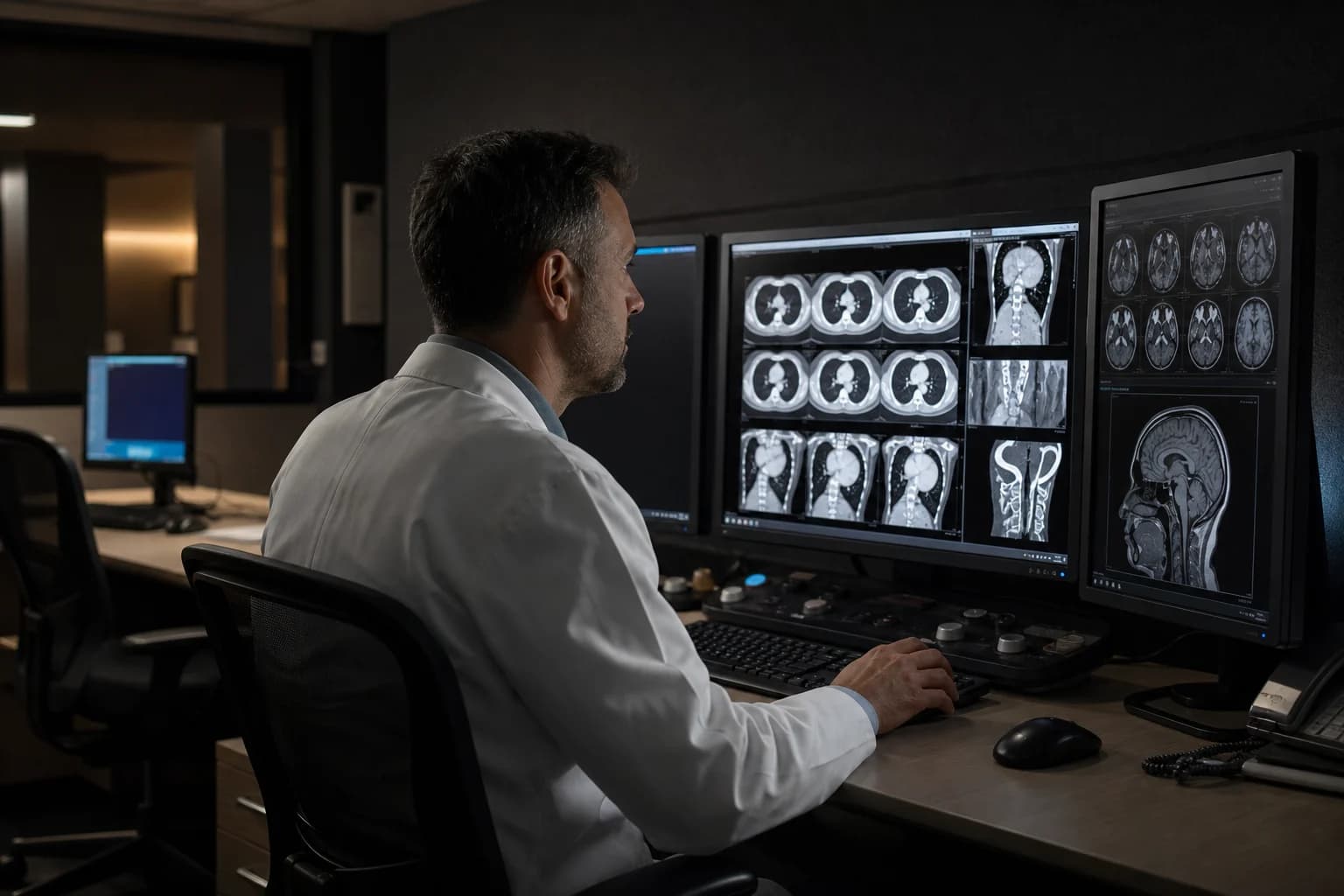
One team for the software,the operations, and the projects.
Most practices buy these three from three different places: an agency that has never seen a DICOM header, a PACS administrator who cannot write software, and a consultancy that leaves after the slide deck. We do all three, which is why the migration plan and the dashboard that measures it come from the same people.
Built for referrers,patients, and the front desk.
Your PACS was never meant to be a referral portal, and your RIS was never meant to be a dashboard. We build the layer around them — HL7 and FHIR aware, so it reads from the systems of record instead of asking someone to retype an order.
Referring-physician portals
Order placement, exam status, report and image access under credential-scoped logins — so the referring office stops calling the front desk and the fax loop finally closes.
Order intake and scheduling
Insurance and authorization capture, prep instructions, and modality- and protocol-aware slotting, with reminders that measurably cut no-shows on high-value exams.
Patient results and self-scheduling
Self-serve booking, results release rules that respect your policy and the Cures Act, and image-share links a patient can hand to the next specialist.
Operational dashboards
Turnaround time by segment — order to exam, exam to prelim, prelim to final — plus exam volume by modality and site, modality utilization, and RVU by radiologist and shift.
HL7 and FHIR aware development
Apps that speak ADT, ORM, ORU and SIU, and FHIR ImagingStudy where the stack supports it, instead of screen-scraping a system that will change next upgrade.
Marketing sites that book exams
The practice website itself: fast, accessible, findable for the exams you want to grow, and wired to the same intake pipeline as everything else you run.
Spartan Radiology
We designed and built spartanrad.com for Spartan Radiology, a teleradiology practice whose buyers are hospital and imaging-center administrators. The brief was credibility in five seconds: subspecialty coverage, turnaround expectations, and coverage model legible before a single scroll — because the person evaluating a reading group is not browsing, they are shortlisting.
The PACS administrator seat,without the hire.
Most groups are one person deep on PACS, and that person is also the RIS admin, the modality liaison and the vendor wrangler. PACS administrator services on a retainer give you the same coverage with a documented escalation path and no single point of failure — across PACS, VNA, RIS, dictation platforms such as PowerScribe and Fluency, zero-footprint viewers and image sharing.
Book a scoping call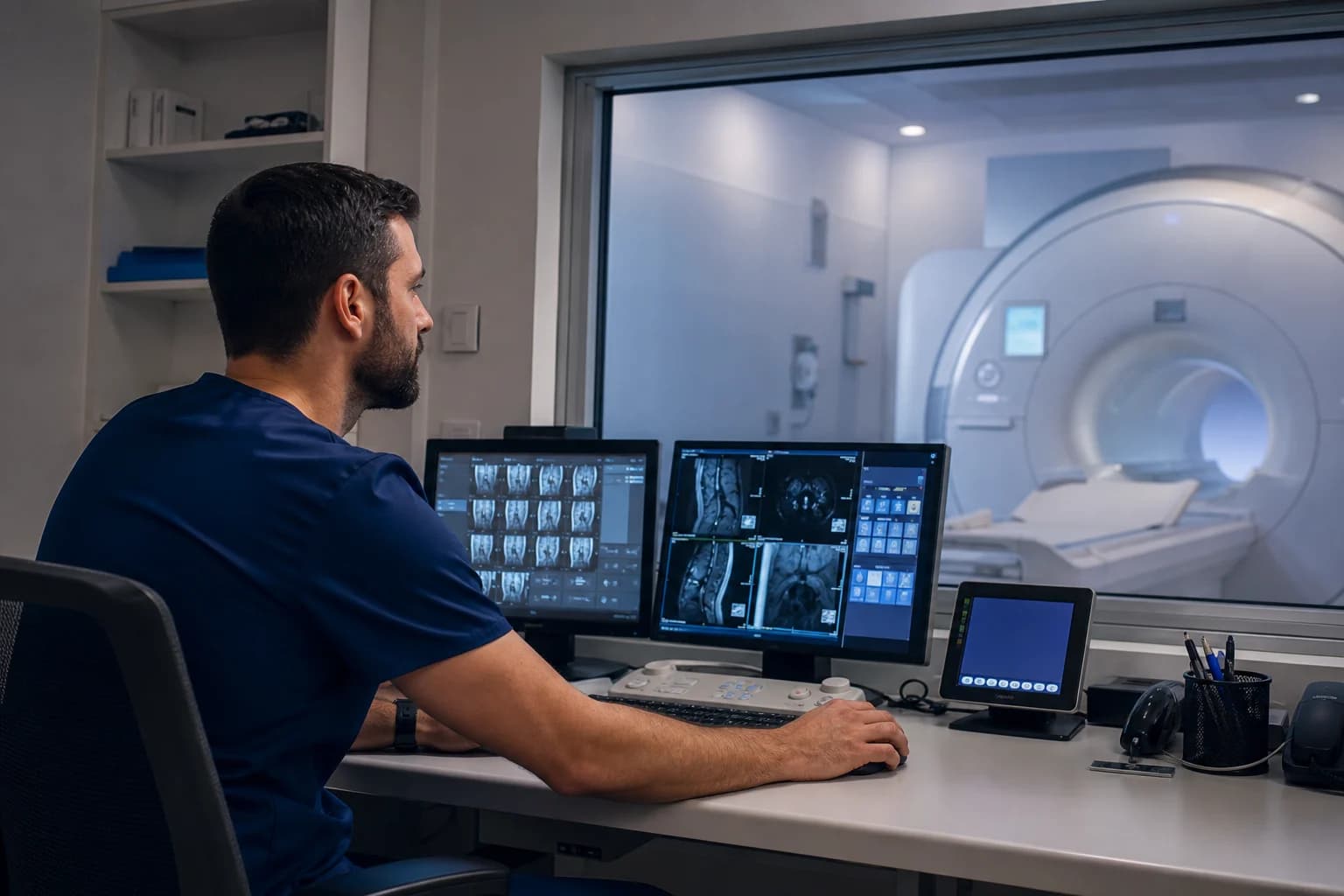
At the modality, not just behind a ticket queue.
The hard problems happen where worklists, devices and people meet. We test the clinical workflow with the technologists who use it before a change is called complete.
DICOM services
C-STORE, C-FIND, C-MOVE, MPPS, Storage Commitment and Modality Worklist — AE title mapping, association failures, transfer syntax mismatches, and routing that quietly stopped.
QC and exception queue
Mismatched MRN or accession, wrong-patient studies, merges, splits and moves, laterality and body-part corrections, and reconciling outside priors so comparisons are actually there at read time.
Modality onboarding
AE titles, IP and port assignment, Modality Worklist configuration, routing and prefetch rules, test patients, and acceptance testing before the first live patient is scanned.
Storage, retention and DR
Tiering across fast and archival storage, retention schedules by modality and state requirement, backup posture, and restore tests that are actually run rather than assumed.
Hanging protocols and worklists
Per-radiologist hanging protocols, worklist design, and subspecialty, site and STAT routing — the difference between a reading room that flows and one that fights the software.
Diagnostic monitor QA
DICOM GSDF Part 14 calibration and ACR-conformant display QA on diagnostic workstations, with the documentation your accreditation survey is going to ask for.
HIPAA audit logging
Audit logging verified as switched on and reviewable, access reviewed as least-privilege and named, and findings written up in language your compliance officer can file.
De-identification and image sharing
PHI de-identification for teaching files, research and AI training sets — including burned-in annotation, not just header tags — plus outbound image sharing that referrers will use.
Migrations and integrationsthat keep the reading room open.
An imaging informatics consultant earns their fee in the parts nobody demos: the identity mapping, the exception classes, the delta pass nobody scheduled, and the rollback path you hope never to use. Every engagement below is fixed-scope and priced after discovery — never off a rate card.
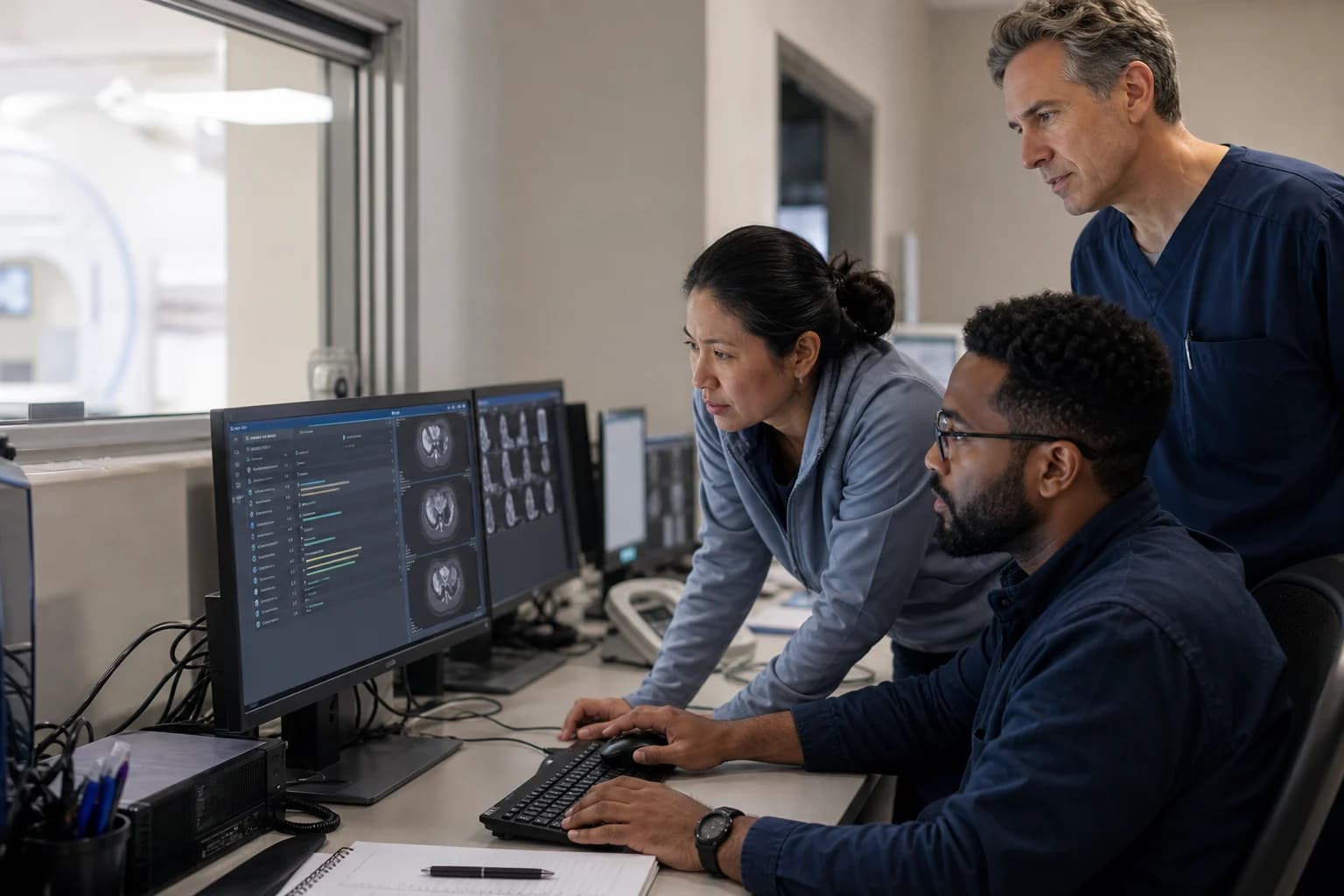
The plan has to survive the reading room.
We work the migration with clinical, operational and technical owners in the same loop—then reconcile what moved, what failed and what still needs a human decision.
PACS and VNA migration services
The flagship engagement. Throughput math before the calendar, tag morphing rules, MRN and accession mapping, orphan and exception handling, bulk migration with repeated delta passes, and study-by-study reconciliation before cutover.
- Throughput and calendar modeling
- Tag morphing and identity mapping
- Delta passes and reconciliation
DICOM and HL7 integration architecture
HL7 v2 ADT, ORM, ORU and SIU flows through Mirth, Cloverleaf, Rhapsody or Corepoint; IHE profiles including Scheduled Workflow, XDS-I, PIX and PDQ; DICOMweb via WADO-RS, QIDO-RS and STOW-RS; and FHIR ImagingStudy where the modern stack expects it.
- Interface engine build and rework
- IHE-conformant workflow design
- DICOMweb and FHIR endpoints
AI deployment plumbing
Triage models in the Aidoc and Viz.ai mold, orchestrated through Nuance PIN or Blackford when more than one is in play, with results returning as secondary capture, GSPS or structured reports — on the worklist, where a radiologist will see them.
- Study routing and orchestration
- Results back as SC, GSPS or SR
- Worklist prioritization changes
Vendor evaluation and RFPs
Requirements gathering that reflects how your practice really reads, scored evaluation criteria, conformance-statement and interface-spec review, scripted demos, and reference calls that ask the questions vendors hope you skip.
- Scored requirement matrices
- Conformance statement review
- Contract and SLA input
Cutover runbooks and downtime procedures
A minute-by-minute cutover runbook, a rollback path, downtime procedures for order entry and image capture, queue-and-replay for anything acquired during the window, and a communication plan for the reading room and the front desk.
- Runbook and rollback path
- Downtime and replay procedure
- Reading room comms plan
Testing, go-live and hypercare
End-to-end test scripts across order, schedule, acquire, route, read and result; validated priors and prefetch; at-the-elbow support through go-live; and a hypercare window with daily triage before the engagement closes.
- End-to-end test scripts
- At-the-elbow go-live support
- Hypercare with daily triage
Do the arithmetic first.Then pick the date.
Inventory and throughput math
Study count, object count, terabytes, source read rate under real load, and target ingest rate. Those four numbers produce the calendar — before anyone commits to a date.
Mapping and tag morphing
MRN and accession crosswalks, tag morphing rules, institution and AE title normalization, and a written decision for every orphan and exception class we find.
Pilot slice
A bounded, representative slice moves first: multi-modality, with priors, with known-bad records. Radiologists read against it before anything else moves.
Bulk migration and delta passes
Background migration throttled to protect production, then repeated delta passes so studies created after the last sweep are never left behind on the old archive.
Reconciliation, cutover and hypercare
Counts reconciled study by study, routing flipped on a runbook with a rollback path, and a hypercare window with daily exception triage before we hand back the keys.
Software has a price list.Migrations get scoped.
We publish what we can honestly publish. A website or portal build has a known shape, so it has a number. A retained PACS administrator or an archive migration depends on your study counts, coverage window and vendor mix — quoting either before discovery would be a guess dressed up as a price. See full software pricing
Practice sites and portals. Custom platforms and integrations from $6,000.
- Referral portal or patient-facing app
- Operational dashboards (TAT, volume, RVU)
- HL7 and FHIR aware integration work
- Hosting, SSL and care plan included
Monthly retainer sized to your modality count, site count and coverage window.
- Named PACS administrator and escalation path
- Defined coverage hours plus on-call rotation
- Exception queue, DICOM services, monitor QA
- BAA signed before any access to PHI
Fixed scope and fixed price, set after a discovery phase that produces the plan.
- PACS or VNA migration, end to end
- Integration architecture and interface build
- AI deployment plumbing and orchestration
- Cutover runbook, go-live and hypercare
On-site in New Jersey. Remote wherever the studies live.
We are based in Sparta, Sussex County, which means PACS support across New Jersey is a drive, not a flight — modality acceptance testing, monitor QA and go-live weekends included. Everything else, from exception queue work to a multi-site VNA migration, runs remotely through your access paths.
- Sussex County, NJ
- Morris County, NJ
- Bergen County, NJ
- Essex & Union County, NJ
- New York City
- Remote, nationwide
Practices, imaging centers, and reading groups.
Outpatient imaging centers
One to a dozen sites, mixed modality, and a PACS that grew by accretion. Usually arriving with a retention bill, a broken worklist, or a vendor renewal on the calendar.
Radiology groups and teleradiology
Distributed readers, several facility PACS, and priors that never show up on time. Routing, prefetch and worklist design are where the hours go.
Hospital imaging departments
Integration-engine work, IHE-conformant workflow, migrations off end-of-life archives, and coexisting cleanly with a hospital IT team that owns the network.
What does outsourced PACS administration actually cover?
The working seat, not a help desk. Day to day that means the exception and QC queue (mismatched MRN or accession, wrong-patient studies, merges, splits and moves, laterality and body-part corrections, reconciling outside priors), DICOM service troubleshooting across C-STORE, C-FIND, C-MOVE, MPPS, Storage Commitment and Modality Worklist, routing and prefetch rules, hanging protocols and worklist changes, modality onboarding, storage tiering and retention, backup and DR checks, diagnostic monitor QA, and HIPAA audit-log review. You get a named PACS administrator and a documented escalation path instead of a ticket queue.
How do you handle after-hours, weekends, and on-call?
Imaging does not stop at 6pm, so coverage is part of the scope, not an add-on you discover later. Retainers define business-hours coverage plus an on-call rotation with a named escalation contact, a response target per severity, and a written definition of what counts as a severity-one event — studies not reaching the PACS, worklist down, a modality unable to send, or readers locked out. Teleradiology groups reading overnight typically buy wider coverage windows; a single outpatient site usually does not need to.
What does a PACS or VNA migration cost, and how long does it take?
It is scoped per engagement, because the two numbers that drive it are your study count and your sustained transfer rate — not a package tier. We start by measuring: total studies, object counts, terabytes, source system throughput under real load, and how many studies per day the target can actually ingest. That arithmetic produces an honest calendar before anyone signs. A single-site outpatient migration of a few hundred thousand studies is usually weeks; a multi-site archive in the millions runs months of background migration with delta passes. Book a scoping call and we will do the throughput math with your numbers.
Do you work with our existing PACS, VNA, and RIS vendors?
Yes — we are vendor-neutral by design and we are not reselling anyone. Most of our work is making systems you already own behave: your PACS, your VNA, your RIS, your dictation platform (PowerScribe, Fluency), your zero-footprint viewer, your image-sharing service. We sit on your side of vendor calls, hold vendors to their DICOM conformance statements and HL7 interface specifications, and write the RFP and evaluation criteria when it genuinely is time to replace something.
Are you HIPAA compliant, and will you sign a BAA?
Yes. We sign a Business Associate Agreement before any access to PHI, and access is least-privilege and named — no shared logins. Work happens through your access paths and your VPN, actions are logged, and we review your PACS and VNA audit logging as part of the engagement rather than assuming it is switched on. When studies are needed for teaching files, research, or AI training, we de-identify them properly: pixel-level burned-in annotation handling, not just a pass over the DICOM header.
How do you handle downtime — planned and unplanned?
With a runbook written before it is needed. Planned downtime gets a maintenance window, a communication plan for the reading room and the front desk, a documented downtime procedure for order entry and image capture, and a queue-and-replay plan so nothing acquired during the window is lost. Unplanned downtime gets the same runbook plus a rollback path and a reconciliation pass afterward, so every study acquired during the outage is confirmed present, correctly identified, and readable before the incident is closed.
Can you integrate AI triage tools with our PACS?
That is one of the most common projects we take. The clinical model is the vendor problem; the plumbing is ours. We handle the routing rules that decide which studies reach the algorithm, orchestration through platforms like Nuance PIN or Blackford when several models are in play, and getting results back where a radiologist will actually see them — secondary capture, GSPS overlays, or structured reports landing on the worklist, not in a separate portal nobody opens. We also handle the worklist prioritization changes that make triage output mean something.
Do you support teleradiology groups and remote readers?
Yes. Remote reading is mostly a routing, latency, and identity problem: getting the right studies and priors to the right reader fast, keeping worklists split correctly by subspecialty, site, and STAT status, making zero-footprint viewing usable over a home connection, and keeping credentialing and audit trails clean across facilities. We built spartanrad.com for Spartan Radiology, a teleradiology practice, so this is familiar ground rather than a new vertical for us.
Bring us the study that will not open.We will start there.
A scoping call is a working session, not a pitch: what is on your worklist, what is on your renewal calendar, and what would have to be true for this to be someone else's problem. Bring your study counts if you have them.